U.S. Department of the Interior
Building a career compass for Interior’s current and future workforce
The U.S. Department of the Interior stewards more than 500 million acres of public land, protects wildlife, and honors nation-to-nation relationships with Tribes, work carried out by more than 70,000 employees spread across nine bureaus and hundreds of distinct occupations, from wildland firefighters to archaeologists to criminal investigators.
The Challenge
The U.S. Department of the Interior stewards more than 500 million acres of public land, protects wildlife, and honors nation-to-nation relationships with Tribes, work carried out by more than 70,000 employees spread across nine bureaus and hundreds of distinct occupations, from wildland firefighters to archaeologists to criminal investigators. That scale is DOI's greatest asset and, for anyone trying to navigate a career inside it, its biggest obstacle.
DOI's workforce is its mission. But the sheer size and complexity of the agency made it nearly impossible for employees and job seekers to see a clear way forward.
Thousands of job classifications, dozens of occupational series, and a tangle of bureau-specific paths meant the bigger picture — how does my experience translate into what's next? — got buried in the details. A wildland firefighter looking to move into emergency management, or a recent graduate trying to figure out where a degree in environmental science might lead, had no easy way to connect the dots. The information needed to plan a career at DOI existed somewhere in the system, but there was no clear, personal route to it.
DOI needed to recruit and retain future-ready talent at every level: subject matter experts, frontline staff in historically hard-to-fill roles, and the next generation of agency leadership, and a confusing career landscape made all three harder. Compounding the problem, DOI's own staff faced an enormous manual undertaking just to understand what skills and training already existed across the agency: an early effort to analyze the text of thousands of historic course competencies was projected to take 18 months by hand.
DOI needed a way to turn its scale from a liability into an advantage, to give both prospective and current employees a direct, personalized line from where they stood today to where they could go next.
The impact
- 6×Faster competency analysis
- 24%Increase in click-through rates for job-related searches
- 5%Increase in monthly clicks
Project at a glance
- Impact Area
- Effective Government
- Capabilities
- Product Strategy, Technology, AI/ML
- Tech Stack
- AI/ML, Drupal, React, Acquia Cloud, Solr, GA4
Deliverables
- AI/ML strategy consulting & product roadmap
- Drupal & React career exploration application
- "Find Your Path" interactive assessment tool
- Competency Alignment Model (NLP-based)
- Acquia Cloud hosting, search & DevOps support
- Ongoing maintenance, enhancement & customer support
Our approach
Forum One, working alongside AI/ML partner Polydelta, took a product-based approach rather than a one-off technology build.
We started with strategy: structured exercises with DOI stakeholders to define clear objectives, identify where AI and machine learning could realistically deliver value, and map the activities needed to get there before writing a line of code.

That groundwork shaped two connected pieces of what is now My DOI Career:
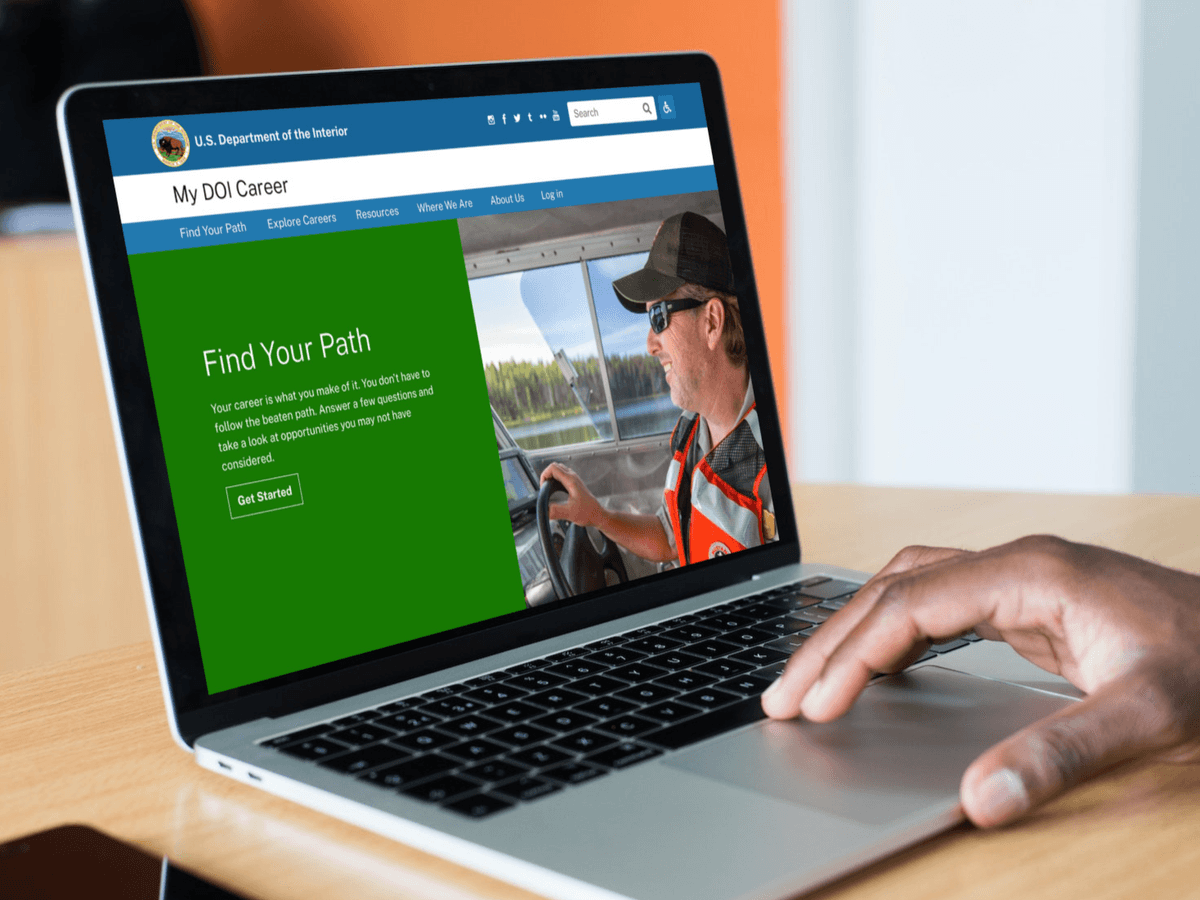
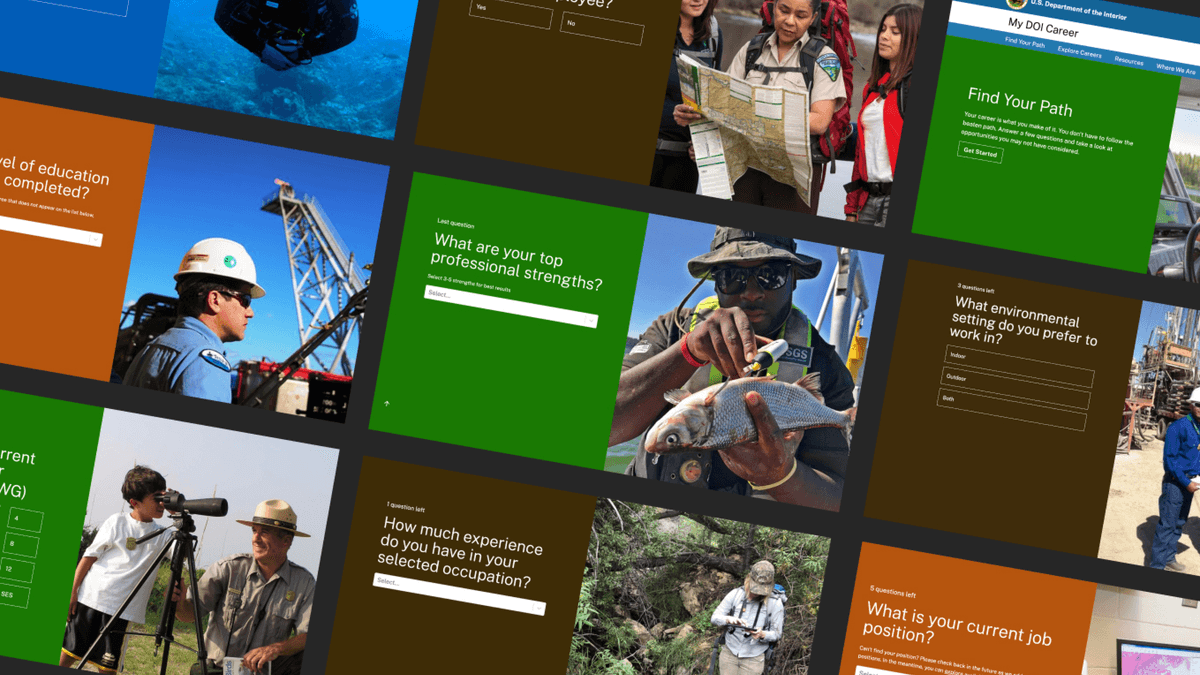
- An engaging, quiz-based matching experience. Rather than asking job seekers to wade through job listings or org charts, the tool asks a few direct questions — federal employment status, education, experience, professional strengths — and uses AI to match each person to relevant career opportunities and resources. It gives people an entry point that starts with them, not with DOI's internal structure.
- An AI-driven career-pathing engine. We helped build a platform that uses natural language processing to read and categorize the competencies behind thousands of training courses, then uses that data to map how completed coursework connects to future roles. This automated a process that had been done by hand, and made it repeatable for new courses and occupations going forward.
Together, these two pieces let DOI offer something genuinely new: a system that takes the complexity of a 70,000-person, multi-bureau agency and translates it into a personal, legible path for the individual standing in front of it.
The Solution
The most immediate impact was speed and scale.
The course-competency analysis that DOI staff had planned to complete manually over 18 months was finished in three months, a six-fold gain in efficiency, and the process is now automated for future analyses, so the agency doesn't start from scratch every time its training catalog grows.
The tool also changed how people found and engaged with DOI careers online. Following the launch and an SEO-focused collaboration with Forum One, the site saw a 5% increase in monthly clicks, with click-through rates for job-related searches up 24%.
But the deeper impact is harder to capture in a single metric. By giving employees and job seekers a way to see their own path through DOI's complexity — instead of getting lost in it — the tool directly supports the workforce outcomes DOI cares about most: stronger recruitment into hard-to-fill frontline roles, better retention because people can see where they're headed, and a clearer leadership pipeline for the agency's future. For a department whose work depends on the people doing it, giving them a clear path forward isn't a convenience, it's workforce readiness.
Let’s talk about a solution for you
Ready to accelerate your mission? Partner with our team to build what’s next.
Start a project